About 156 minutes
Migration of Birds (1950) — Background and Themes
Birds
35,796 recorded words. 1 minutes difference from this book's estimate.
View Gutenberg source #65173
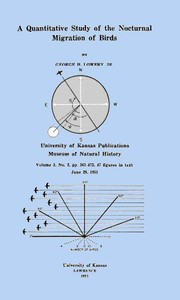
For A Quantitative Study of the Nocturnal Migration of Birds — Key Ideas to Explore, the stored edition analysis reports 35,579 words, 2 hr 35 min estimated reading time, and 9 detected text sections.
The text analysis averages about 21.1 words per sentence, while the detected sections provide another way to judge how the source is divided.
Project Gutenberg metadata also associates the work with “Birds -- Migration,” connecting these edition facts with the source record’s subject description.
Explore this collection
These alternatives are selected using recorded categories and estimated reading time.
About 156 minutes
Birds
35,796 recorded words. 1 minutes difference from this book's estimate.
View Gutenberg source #65173About 152 minutes
Birds
34,875 recorded words. 3 minutes difference from this book's estimate.
View Gutenberg source #16255About 147 minutes
Birds
33,719 recorded words. 8 minutes difference from this book's estimate.
View Gutenberg source #37210Search stored excerpts and compare books → Choose by your preferences →
Choices use stored catalog measurements. Estimates vary with reading speed. A shared category is a catalog label, not a claim that two books have the same argument or literary quality.
Search reads excerpt text stored with this catalog and links to its associated Gutenberg record. The connection is stored in the site database; this tool does not recheck that every excerpt is word-for-word identical to that external record. Excerpt search does not cover every chapter and does not verify historical publication dates.
Catalog snapshot checked: 2026-09-25. Coverage: 100 public books, 100 available source excerpts.
Read the complete public-domain text at its original source.
Read on Project GutenbergGeorge H. Lowery, Jr.'s 1951 monograph turns the moon into a scientific instrument. By stationing observers at a telescope aimed at the lunar disk, he counted birds crossing the illuminated face—a method that transformed fleeting silhouettes into measurable data. The study, published as part of the University of Kansas Museum of Natural History series, spans from Baton Rouge to Yucatán, tracking migration on narrow fronts and across continents.
Lowery's work is built around the concept of "flight density": the number of birds passing per unit of time and space. The text is dense with figures, formulas, and field forms, but its core is a sustained effort to make the invisible visible. Readers will find a meticulous record of how science was done in the mid-20th century—complete with hand-plotted graphs and careful caveats about sampling bias.
Lowery's central innovation is the "cone of observation," a theoretical volume of space defined by the observer's telescope and the moon's position. Birds crossing this cone appear as dark specks against the lunar surface. The geometry is precise: the cone's diameter changes with the moon's altitude, and the observer must account for the moon's apparent motion across the sky. Figures 1 through 5 in the text illustrate how the field of view shrinks or expands, and how this affects density calculations.
The method is not without limitations. Lowery acknowledges that birds flying parallel to the moon's edge may be missed, and that vertical components of flight—birds climbing or descending—introduce error. He devotes several pages to correcting for these factors, using trigonometric adjustments and probability models. The result is a system that, while labor-intensive, allows for quantitative comparison across nights and locations.
One of the most striking patterns Lowery documents is the rapid decline in migration density after midnight. At Baton Rouge, Louisiana, where the study began, birds "virtually disappeared from the sky after midnight." The density would peak before ten o'clock, then fall sharply. This pattern is captured in Figure 30, which shows curves for five nights with a consistent shape: a steep ascent, a brief plateau, and a steep descent.
Lowery connects this to European research on caged birds, particularly Palmgren's work on "nightly migratory restlessness" (Zugunruhe). The caged birds showed a similar rhythm: a period of sleep after twilight, then increasing activity that peaked before midnight. Lowery hypothesizes that wild migrants follow the same schedule—rising in waves, then descending as the urge subsides. He notes that birds killed at the Empire State Building on September 10-11, 1948, began striking "shortly after midnight," consistent with a late peak in some locations.
Lowery's observations extend from Louisiana to Tampico, Mexico, and Progreso, Yucatán. He finds that migration density varies not only by hour but by latitude and topography. At Tampico, the cone of observation shifts dramatically as the moon moves, and the density patterns differ from those at inland sites. Figure 25 shows the positions of the cone at Tampico, illustrating how coastal geography influences the apparent flow of birds.
The continental density pattern, Lowery argues, is shaped by "narrow fronts"—concentrated streams of migrants following coastlines or river valleys. He uses data from multiple stations to map these corridors, noting that the Gulf Coast acts as a funnel. The study stops short of a full continent-wide model, but the groundwork is laid for later radar-based studies.
Lowery devotes a section to the relationship between migration and weather, but the excerpts show he is cautious. He notes correlations with wind direction, temperature, and cloud cover, but avoids claiming causation. The data are sparse: a few nights of observation at a handful of sites. He writes that "by far the most striking correlation" is with the activity patterns of caged birds, not with any single weather variable.
The text is honest about its gaps. Lowery repeatedly uses phrases like "it may be noted" and "all of these observations are of significance in connection with the conclusions herein advanced," signaling that he is building a case from limited evidence. Readers should expect a work that raises as many questions as it answers—a starting point for future research rather than a definitive statement.
Lowery's monograph is best read as a methodological artifact and a snapshot of ornithology before radar. The careful attention to geometry, the hand-drawn figures, and the candid discussion of error make it a valuable document for historians of science. For birders and migration researchers, it offers a baseline: a pre-technological attempt to count what flies overhead. The patterns Lowery saw—the midnight drop-off, the coastal funnels—have been confirmed by later studies, but the charm of this work lies in its ingenuity and its humility.
Moon-watching, night after patient night, with only the passing silhouettes against a bright disk—it felt like waiting for a whispered secret. That quiet, persistent wonder in the 1951 monograph reminded me of another kind of longing entirely, the one in Beautiful Birds — Background and Themes. Not the counting, but the being counted on, somehow, by the very darkness itself.
Create a short personal record of your experience with this book.