About 155 minutes
A Quantitative Study of the Nocturnal Migration of Birds — Key Ideas to Explore
Birds
35,579 recorded words. 1 minutes difference from this book's estimate.
View Gutenberg source #37894
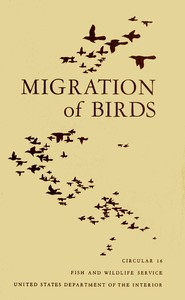
Migration of Birds (1950) — Background and Themes can be approached with a clearer sense of reading commitment from its source measurements: 35,796 words, 2 hr 36 min estimated reading time, and 24 detected text sections.
The text analysis averages about 24.9 words per sentence, while the detected sections provide another way to judge how the source is divided.
Project Gutenberg metadata also associates the work with “Birds,” connecting these edition facts with the source record’s subject description.
Explore this collection
These alternatives are selected using recorded categories and estimated reading time.
About 155 minutes
Birds
35,579 recorded words. 1 minutes difference from this book's estimate.
View Gutenberg source #37894About 152 minutes
Birds
34,875 recorded words. 4 minutes difference from this book's estimate.
View Gutenberg source #16255About 147 minutes
Birds
33,719 recorded words. 9 minutes difference from this book's estimate.
View Gutenberg source #37210Search stored excerpts and compare books → Choose by your preferences →
Choices use stored catalog measurements. Estimates vary with reading speed. A shared category is a catalog label, not a claim that two books have the same argument or literary quality.
Search reads excerpt text stored with this catalog and links to its associated Gutenberg record. The connection is stored in the site database; this tool does not recheck that every excerpt is word-for-word identical to that external record. Excerpt search does not cover every chapter and does not verify historical publication dates.
Catalog snapshot checked: 2026-09-25. Coverage: 100 public books, 100 available source excerpts.
Read the complete public-domain text at its original source.
Read on Project GutenbergFrederick C. Lincoln's Migration of Birds (1950) opens not with a thesis but with a question: "Where do they go?" The book, Circular 16 of the U.S. Fish and Wildlife Service, immediately frames migration as a puzzle shared by farmers, bird students, and hunters. Lincoln, a biologist, draws on decades of banding studies and field observations to map the seasonal movements of North American birds. The text is dense with specific routes—brant traveling from the Canadian Arctic to the Gulf of St. Lawrence, canvasbacks crossing Pennsylvania to reach Chesapeake Bay—and grounded in data from sources like Lewis (1937) and recovery records of banded ducks. Bob Hines's illustrations complement the scientific tone, making this a government publication that doubles as a natural history reference.
The catalog lists "Birds" and "Birds -- Migration" as subjects, which accurately reflect the book's scope but understate its granularity. Lincoln does not merely state that birds migrate; he dissects the phenomenon into measurable components: speed of flight, altitude, orientation, and the segregation of species during travel. For instance, he notes that the white-winged scoter was "credited with an elliptical migration route," a claim backed by banding recoveries. The text also ventures into evolutionary theories—northern vs. southern ancestral home, photoperiodism, continental drift—showing that the catalog's simple headings mask a work that engages with competing hypotheses. Readers expecting a dry list of species will instead find a nuanced argument about how and why migration patterns evolved.
Lincoln repeatedly anchors his claims in empirical evidence, particularly bird banding. He describes how "recovery records of ducks banded at Lake Scugog, Ontario" demonstrated a split route: some birds continued down the Ohio Valley, while others swung southeast to the Atlantic coast. This reliance on data distinguishes the book from earlier speculative works. The appendix on bird banding further underscores the methodological focus. However, the excerpts do not reveal the full scope of Lincoln's analysis; for example, the discussion of the white-throated sparrow's migration is mentioned in the table of contents but not excerpted. Readers should note that the book's conclusions are provisional, built on the banding technology of its time.
A significant portion of the book addresses the dangers birds face: storms, aerial obstructions, and exhaustion. Lincoln writes from a conservationist perspective, noting that farmers "profit by their tireless warfare against the weed and insect pests." The text balances scientific detachment with an implicit call for stewardship. The section "Perils of migration" includes subsections on storms and exhaustion, but the excerpts do not detail specific mortality events. Instead, Lincoln emphasizes the complexity of migration as a survival strategy. The book's tone is that of a government circular—authoritative yet accessible—aimed at informing policy and public understanding. This practical orientation, combined with the detailed route maps, makes the work a precursor to modern conservation biology.
Lincoln's Migration of Birds rewards readers who appreciate data-rich natural history. The book's strength lies in its specificity: the brant's 570-mile overland flight, the canvasbacks' path through the Great Lakes, the scoters' elliptical routes. Yet the excerpts leave many questions unanswered—the full discussion of photoperiodism, the vertical migration of mountain birds, the vagrant individuals that stray off course. Approach this text as a snapshot of mid-century ornithology, grounded in banding records and field observation, and you will find a meticulous account of one of nature's great phenomena.
Reading about the 1950 Migration of Birds, I remembered my father’s old field notes, margins filled with arrows and question marks. This quieter science brought back that same patient thrill. I found a similar feeling in Life histories of North American shore birds, Part 1 (of 2) — Key Ideas to Explore, where each species feels like a slow, hand-written letter about weather and mudflats.
Create a short personal record of your experience with this book.