About 171 minutes
Bird Stories from Burroughs Sketches of Bird Life Taken from the Works of John Burroughs — Reading Notes
Birds
39,297 recorded words. 9 minutes difference from this book's estimate.
View Gutenberg source #26046
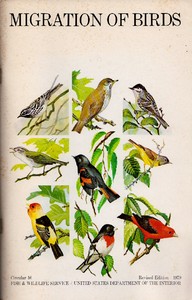
Migration of Birds (1979) — Text and Context can be approached with a clearer sense of reading commitment from its source measurements: 41,199 words, 3 hr estimated reading time, and 26 detected text sections.
The text analysis averages about 21.0 words per sentence, while the detected sections provide another way to judge how the source is divided.
Project Gutenberg metadata also associates the work with “Birds,” connecting these edition facts with the source record’s subject description.
Explore this collection
These alternatives are selected using recorded categories and estimated reading time.
About 171 minutes
Birds
39,297 recorded words. 9 minutes difference from this book's estimate.
View Gutenberg source #26046About 199 minutes
Birds
45,597 recorded words. 19 minutes difference from this book's estimate.
View Gutenberg source #18237About 156 minutes
Birds
35,796 recorded words. 24 minutes difference from this book's estimate.
View Gutenberg source #65173Search stored excerpts and compare books → Choose by your preferences →
Choices use stored catalog measurements. Estimates vary with reading speed. A shared category is a catalog label, not a claim that two books have the same argument or literary quality.
Search reads excerpt text stored with this catalog and links to its associated Gutenberg record. The connection is stored in the site database; this tool does not recheck that every excerpt is word-for-word identical to that external record. Excerpt search does not cover every chapter and does not verify historical publication dates.
Catalog snapshot checked: 2026-09-25. Coverage: 100 public books, 100 available source excerpts.
Read the complete public-domain text at its original source.
Read on Project GutenbergFrederick C. Lincoln's Migration of Birds (1979) opens with a striking comparison: a golden plover crossing 2,400 miles of ocean on less than two ounces of body fat. This image sets the tone for a work that consistently uses concrete, quantified examples to illustrate abstract concepts. The prose is direct and pedagogical, often addressing common misconceptions—such as the notion that migrants arrive exhausted—with measured, evidence-based rebuttals. Lincoln's voice is that of a patient instructor, guiding the reader through technical material with clarity and occasional dry humor.
Lincoln frequently deploys precise numbers to dramatize avian physiology. The golden plover's 48-hour flight and the ruby-throated hummingbird's crossing of 500 miles on less than a gram of fat are not mere facts but rhetorical devices. By juxtaposing these figures with human aviation—a 1,000-pound airplane requiring a gallon of fuel for a 20-mile flight—he frames migration as a marvel of engineering. This quantitative diction serves a dual purpose: it educates while implicitly arguing for the superiority of natural design. The author avoids hyperbole, letting the numbers speak for themselves, which lends the text an air of scientific authority.
Lincoln frequently anticipates and counters popular beliefs, creating a dialogic structure. He writes that the notion of birds sinking exhausted upon reaching land 'generally does not coincide with the facts,' and notes that even the sora—dismissed by one writer as a weak flyer—crosses the Caribbean. These passages function as corrections, but Lincoln's tone remains collegial rather than confrontational. He uses phrases like 'one might expect' to introduce a misconception, then refutes it with observational evidence. This technique not only informs but also builds trust, positioning the reader as a fellow inquirer rather than a passive recipient of facts.
In the section on routes, Lincoln is careful to qualify his terminology. He calls 'migration route' a 'theoretical concept,' warning against assuming that grounded migrants indicate main paths. This caution reflects a descriptive style that prioritizes accuracy over simplicity. The prose is dense with hedging phrases—'to some extent,' 'usually,' 'one ought to have recourse'—that signal the provisional nature of ornithological knowledge. Lincoln's descriptions of flyways and corridors avoid sweeping generalizations, instead emphasizing 'infinite variety' and the need for probabilistic reasoning. This meticulousness distinguishes the work from popular natural history writing of its era.
Despite its title, the 'Perils of Migration' chapter is notably restrained. Lincoln devotes space to exhaustion only to dismiss it as a major threat, arguing that birds under favorable conditions 'can fly when and where they please.' The real perils—storms, aerial obstructions, and modified ceilometers—are treated with clinical brevity. This understatement is a deliberate authorial choice: by downplaying dramatic hazards, Lincoln reinforces the theme of avian resilience. The passage on soaring birds as 'the most perfect machine for extensive flight' echoes earlier quantitative comparisons, tying the section back to the book's central argument about efficiency and adaptation.
Readers approaching Migration of Birds should attend to how Lincoln balances technical detail with accessible explanation. His use of analogy, quantitative evidence, and gentle correction of myths reveals a writer deeply invested in public understanding. The 1979 revision, updated by Steven R. Peterson, retains Lincoln's original voice while incorporating newer research. For those interested in the craft of scientific communication, this text offers a model of clarity without oversimplification.
The rain blurred the window as I reread Lincoln's notes on migration, how he weighed a bird's energy against the vastness of its journey. That frugality of effort stayed with me. Later, drying the pages, I reached for something gentler and found Bird Stories from Burroughs Sketches of Bird Life Taken from the Works of John Burroughs — Reading Notes, where the same birds paused to simply be.
A brief reflection can help important ideas stay with you longer.