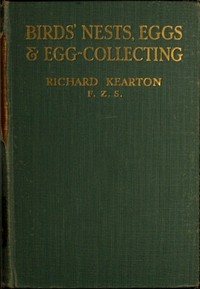
Richard Kearton opens his 1896 enlarged edition by framing nest-study as "the kernel of ornithology," a phrase that sets the book's practical, field-oriented tone. Rather than a simple identification manual, the preface explicitly discourages "useless collecting from a mere bric-à-brac motive" and instead promotes the "utility of systematic study and close observation." Kearton's voice is that of an experienced naturalist who has "pretty extensive experience" and draws on authorities like Yarrel and Seebohm, but he writes directly to the "youthful naturalist," offering concrete details of nest construction, egg coloration, and habitat.
A Voice of Conservation Before Its Time
Kearton's preface reveals a conservation ethic unusual for 1896. He hopes that the "Act of Parliament empowering County Councils to protect either the eggs of certain birds, or those of all birds breeding within a given area, will be of great benefit to many of our feathered friends." This is not a throwaway line; it frames the entire work as a study aid rather than a collector's handbook. The author repeatedly emphasizes observation over acquisition, a stance that distinguishes this book from many contemporary egg-collecting guides. The language is measured but firm, and the repeated reprintings (ten between 1890 and 1913) suggest that this message resonated with readers.
Precision in Description: Nest, Egg, and Habitat
Each species account follows a consistent structure: nest location, materials, and egg characteristics. For the Dipper, Kearton notes the nest is "generally placed near to some waterfall, and very often behind it, so that the bird has to fly through the water." The Missel Thrush's nest "is composed of dried grass and moss, with a liberal mixture of wool, which helps it to adhere to the bark." Such details are not merely decorative; they serve the young naturalist's need to identify nests in the field. Kearton also records variation—the Spoonbill's eggs "vary in colour, some being entirely white, whilst others are spotted with a light brownish-red"—and acknowledges when authorities disagree, as with the Missel Thrush's egg count. This careful hedging shows a writer who values accuracy over dogmatism.
Pace and Structure: From Common to Rare
The book's arrangement moves from familiar garden birds to rarer species, a logical progression for a beginner. The Hedge-sparrow's nest "in hawthorn hedges" and the Garden Warbler's "loose and slovenly" construction are described early, while the Peregrine Falcon's "noble" cliff nest and the Ptarmigan's "bleak stony mountain-tops" appear later. This pacing allows the reader to build confidence before tackling more challenging identifications. Kearton also varies sentence length: short, factual statements about egg numbers ("She lays from four to six eggs") alternate with longer, more evocative passages about nest placement. The effect is a rhythm that keeps the text engaging without sacrificing precision.
Kearton's guide rewards the reader who reads not just for identification but for the author's quiet advocacy of careful watching over collecting. The repeated reprintings suggest that many young naturalists took his advice to heart. For modern readers, the book offers a window into late-Victorian natural history—its methods, its conservation stirrings, and its faith that close observation could replace the impulse to take.
Flicking through Richard Kearton’s old guide, I paused at his gentle plea to watch nests rather than empty them. That quiet respect for a living shoreline drifted me back to a rainy afternoon spent with British Sea Birds — Context and Discussion, where the same patient wonder lingers between the pages, like tide pools left behind.