About 199 minutes
A Bird Calendar for Northern India — Reading Notes
Birds
45,597 recorded words. 7 minutes difference from this book's estimate.
View Gutenberg source #18237
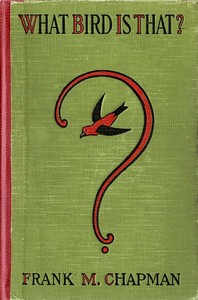
For What bird is that? — A Reader’s Guide, the stored edition analysis reports 47,343 words, 3 hr 26 min estimated reading time, and 11 detected text sections.
The text analysis averages about 11.0 words per sentence, while the detected sections provide another way to judge how the source is divided.
Project Gutenberg metadata also associates the work with “Birds -- United States,” connecting these edition facts with the source record’s subject description.
Explore this collection
These alternatives are selected using recorded categories and estimated reading time.
About 199 minutes
Birds
45,597 recorded words. 7 minutes difference from this book's estimate.
View Gutenberg source #18237About 216 minutes
Birds
49,629 recorded words. 10 minutes difference from this book's estimate.
View Gutenberg source #25600About 216 minutes
Birds
49,551 recorded words. 10 minutes difference from this book's estimate.
View Gutenberg source #50276Search stored excerpts and compare books → Choose by your preferences →
Choices use stored catalog measurements. Estimates vary with reading speed. A shared category is a catalog label, not a claim that two books have the same argument or literary quality.
Search reads excerpt text stored with this catalog and links to its associated Gutenberg record. The connection is stored in the site database; this tool does not recheck that every excerpt is word-for-word identical to that external record. Excerpt search does not cover every chapter and does not verify historical publication dates.
Catalog snapshot checked: 2026-09-25. Coverage: 100 public books, 100 available source excerpts.
Read the complete public-domain text at its original source.
Read on Project GutenbergFrank M. Chapman, Curator of Birds at the American Museum of Natural History, designed What Bird Is That? as a practical field companion that mirrors the museum's 'Seasonal Collection.' Rather than listing all species at once, the book groups birds by the month they are most likely to be seen in the eastern United States. This seasonal arrangement, as Chapman explains, 'correspondingly limits the field of our inquiry' when a reader encounters an unfamiliar bird. The volume also includes a labeled diagram of a Bluebird to teach the names of plumage parts, enabling users to write or understand precise color descriptions.
Chapman's introduction describes a museum exhibit that is revised at the start of each month: 'Permanent Resident Birds' form the base, while migratory species are added or removed as they come and go. The book applies the same logic. In January, the reader only considers birds that winter in the region; in June, only summer residents and migrants. This structure is not merely a convenience—it reflects Chapman's belief that 'the season of occurrence thus gives us an important clue to a bird's identity.' The excerpts show entries for species such as the White-throated Sparrow, which is listed as a common winter visitor in Washington from March 18 to May, and again from September 15 to December 16. By consulting the appropriate seasonal section, the user immediately eliminates hundreds of species that are not present at that time of year.
Each entry follows a compact, data-rich format. A typical account begins with a case number and figure references to the color plates, then lists key field marks in a single sentence. For example, the Tree Sparrow is identified by 'a dusky spot in the center of the breast and a reddish brown cap and streak behind the eye.' Length and range are given next, followed by a table of arrival and departure dates for specific locations: Washington, Ossining, Cambridge, N. Ohio, Glen Ellyn, and SE. Minnesota. These local records, drawn from decades of observation, allow the reader to gauge whether a sighting is early, typical, or late for their area. A short paragraph then describes the bird's habits, song, and call notes—the White-throat's 'characteristic sharp clink' or the Tree Sparrow's 'merry chatter.'
Edmund J. Sawyer's 301 color illustrations are integral to the identification process. The text repeatedly directs the reader to specific figures: 'Case 2, Figs. 45, 46; Case 4, Fig. 40' for the White-throated Sparrow. The transcriber's note explains that clicking on diagrams and full-color illustrations in the digital edition shows a larger version. Chapman assumes the user will compare the bird in hand with these plates, and the written descriptions are designed to supplement, not replace, the visual information. For species with seasonal plumage variation, such as the Chipping Sparrow, the text notes differences between summer and fall: 'in the fall and winter the crown is like the back, the line over the eye is brownish, and the bill is brown; but the gray rump ... is a good character the year around.'
Chapman intended the book to be a 'pocket museum'—portable enough to carry on walks. The seasonal arrangement means a reader can flip to the current month and browse only the relevant species. The range data also helps distinguish similar birds: the White-crowned Sparrow, for instance, is described as 'rare enough in the Eastern States, always to command our attention,' and its migration dates are narrower than those of the abundant White-throat. The book does not assume prior knowledge; the opening diagram teaches basic plumage terminology. For a first-time user, the most efficient approach is to note the date and location of a sighting, then turn to the corresponding seasonal section and scan the plates and descriptions for a match.
Chapman's method—combining seasonal restriction, precise range data, and visual reference—makes What Bird Is That? a tool for active learning rather than a passive encyclopedia. Readers who follow the seasonal clues and compare field marks against Sawyer's plates will find the identification process streamlined, even without prior ornithological training. The book rewards careful attention to the details of plumage, song, and timing that distinguish one species from another.
I found myself thinking of that old field guide’s patient month-to-month lists—one bird sliding into the next, grey junco yielding to goldfinch—and then, softly, I remembered the Myology and Serology of the Avian Family Fringillidae: A Taxonomic Study — Context and Discussion. The way it weighs muscles and blood rather than feathers felt like a deeper, slower echo of that same careful watching.
Build a private reading journal entry for this title.