About 167 minutes
The run — Reading Notes
Marine Life
38,211 recorded words. 85 minutes difference from this book's estimate.
View Gutenberg source #77074
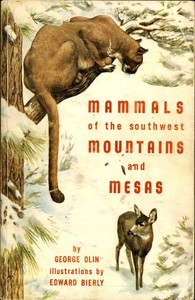
Before opening Mammals of the Southwest Mountains and Mesas — Edition Insights, the edition data offers a quick orientation: 57,810 words, 4 hr 12 min estimated reading time, and 8 detected text sections.
The text analysis averages about 18.8 words per sentence, while the detected sections provide another way to judge how the source is divided.
Project Gutenberg metadata also associates the work with “Mammals -- Southwest, New,” connecting these edition facts with the source record’s subject description.
Explore this collection
These alternatives are selected using recorded categories and estimated reading time.
About 167 minutes
Marine Life
38,211 recorded words. 85 minutes difference from this book's estimate.
View Gutenberg source #77074About 350 minutes
Marine Life
80,455 recorded words. 98 minutes difference from this book's estimate.
View Gutenberg source #46607About 126 minutes
Marine Life
28,861 recorded words. 126 minutes difference from this book's estimate.
View Gutenberg source #34848Search stored excerpts and compare books → Choose by your preferences →
Choices use stored catalog measurements. Estimates vary with reading speed. A shared category is a catalog label, not a claim that two books have the same argument or literary quality.
Search reads excerpt text stored with this catalog and links to its associated Gutenberg record. The connection is stored in the site database; this tool does not recheck that every excerpt is word-for-word identical to that external record. Excerpt search does not cover every chapter and does not verify historical publication dates.
Catalog snapshot checked: 2026-09-25. Coverage: 100 public books, 100 available source excerpts.
Read the complete public-domain text at its original source.
Read on Project GutenbergGeorge Olin's Mammals of the Southwest Mountains and Mesas opens with a clear taxonomic structure, grouping species into hoofed animals, rodents, and carnivores. The prose balances scientific precision with a naturalist's eye for behavior, as when describing the woodrat's nighttime activity: 'A peculiar thumping sound indicates a gait which I have never seen but often heard at night.' Olin's diction is direct, favoring concrete measurements—'Total length 18 to 25 inches. Tail 8 to 11 inches'—over vague descriptors. Edward Bierly's illustrations complement the text, though the excerpts focus on Olin's written observations.
Olin arranges the book by major groups—hoofed animals, rodents, carnivores—each entry following a consistent pattern: range, habitat, description, and behavior. The muskrat entry exemplifies this: 'Range: Virtually all of North America north of the Mexican border. Habitat: This large rodent can exist only near a permanent water supply.' Descriptions are quantitative, noting tail length in inches and weight in pounds, with attention to fur texture and foot structure. This systematic approach allows readers to compare species efficiently, though Olin occasionally inserts personal observations, such as noting the muskrat's 'long, flat tail undulates from side to side when it swims.'
Olin enriches the guide with firsthand behavioral notes. The woodrat section describes a 'peculiar thumping sound' that 'indicates a gait which I have never seen but often heard at night,' suggesting a kangaroo-rat-like leap. He notes the 'ear-splitting silence' following the woodrat's hind-leg alarm signal. For muskrats, he contrasts their typical mound-building in marshes with their 'altered circumstances' in Southwest irrigation canals, where they 'react quite differently' and may go unnoticed. These details hint at Olin's field experience, though the excerpts do not reveal his specific methods or locations.
A recurring theme is species adaptability. Olin writes that the muskrat's 'change in habits required by this different environment illustrates the great adaptability exhibited by many of our most common mammal species.' He emphasizes habitat constraints, such as the need for 'a permanent body of water of a depth sufficient for it to dive into and escape from its enemies.' The woodrat's tolerance of human dwellings is noted with dry humor: 'peacefully, but to the great annoyance of the human occupant.' Olin's focus on how mammals adjust to the Southwest's arid landscapes grounds the guide in ecological reality, though the excerpts do not detail broader conservation concerns beyond a brief preface mention.
Olin's voice is that of an informed naturalist who occasionally steps into the first person. He describes the woodrat's sounds as 'a gait which I have never seen but often heard,' and the 'ear-splitting silence' that 'literally presses in on one in the darkness.' The muskrat section includes a speculative phrase: 'It must be somewhat like the leaping flight of a kangaroo rat.' This blend of empirical data and personal inference gives the text a conversational quality. However, the excerpts are too brief to assess how consistently this voice appears across the full 57,810-word volume. The acknowledgments credit Dr. E. L. Cockrum for accuracy, suggesting a collaborative effort between scientific review and Olin's narrative style.
Readers will find Olin's guide most useful as a reference for identifying Southwest mammals through physical traits and habitat clues. The behavioral anecdotes add texture but should be treated as observations rather than systematic ethology. Bierly's illustrations, though not excerpted here, likely enhance the descriptions. For a fuller understanding, consult the index and references cited at the book's end.
That rainy afternoon, I kept returning to Olin's woodrat—that thumping alarm, a wild pulse in dry arroyos—and felt the ache of a place I'd never seen. Then, almost accidentally, I reached for Subspeciation in Pocket Gophers of Kansas, [KU. Vol. 1 No. 11] — Themes and Context, and the rain softened. Small burrowers, mapped by bone and soil, felt like quiet kin.
Create a short personal record of your experience with this book.



![Cover of Subspeciation in Pocket Gophers of Kansas, [KU. Vol. 1 No. 11] — Themes and Context](https://abgoa.com/storage/media/covers/pg36653.jpg)