About 58 minutes
Mammals taken Along the Alaska Highway — Inside the Classic
Marine Life
13,320 recorded words. 3 minutes difference from this book's estimate.
View Gutenberg source #33915
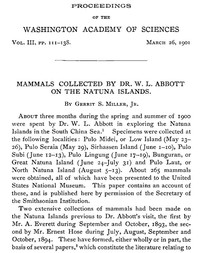
This digital edition of Mammals Collected by Dr. W. L. Abbott on the Natuna Islands Proceedings of the Washington Academy of Sciences, Vol. III, pp. 111-138 — Context and Discussion is described by source-level measurements including 12,473 words, 55 min estimated reading time, and 2 detected text sections.
The text analysis averages about 12.8 words per sentence, while the detected sections provide another way to judge how the source is divided.
Project Gutenberg metadata also associates the work with “Abbott, William Louis, 1860-1936,” connecting these edition facts with the source record’s subject description.
Explore this collection
These alternatives are selected using recorded categories and estimated reading time.
About 58 minutes
Marine Life
13,320 recorded words. 3 minutes difference from this book's estimate.
View Gutenberg source #33915About 66 minutes
Marine Life
15,073 recorded words. 11 minutes difference from this book's estimate.
View Gutenberg source #33659About 39 minutes
Marine Life
8,847 recorded words. 16 minutes difference from this book's estimate.
View Gutenberg source #36653Search stored excerpts and compare books → Choose by your preferences →
Choices use stored catalog measurements. Estimates vary with reading speed. A shared category is a catalog label, not a claim that two books have the same argument or literary quality.
Search reads excerpt text stored with this catalog and links to its associated Gutenberg record. The connection is stored in the site database; this tool does not recheck that every excerpt is word-for-word identical to that external record. Excerpt search does not cover every chapter and does not verify historical publication dates.
Catalog snapshot checked: 2026-09-25. Coverage: 100 public books, 100 available source excerpts.
Read the complete public-domain text at its original source.
Read on Project GutenbergGerrit S. Miller's 1901 monograph opens with a precise itinerary: Dr. W.L. Abbott spent about three months in spring and summer 1900 collecting 265 mammals across seven Natuna Islands. Miller immediately establishes a comparative framework, noting two prior collections by Everett and Hose. The author's diction is deliberately technical, favoring terms like 'insular forms' and 'faunal relationships.' He resists definitive conclusions about biogeographic affinities, stating it 'seems unprofitable' to conjecture on Bornean versus Peninsular connections. This restraint is a hallmark of Miller's voice—cautious, empirical, and focused on specimen-level evidence.
Miller's descriptions rely on meticulous measurement and color notation. For Sciurus lautensis, he gives external measurements in millimeters: total length 375, head and body 195, tail 180, hind foot 44. He references Ridgway's color standard, describing the inner surface of legs as 'bright ochraceous-buff (distinctly more yellow than Ridgway's pl. V, No. 10).' Such specificity is typical. He notes variation in Ratufa bunguranensis pelage, observing a 'drab wash' that varies in amount and is 'more noticeable when the animal is viewed from in front.' These details reveal a writer attuned to subtle gradations and the effects of observation angle.
Miller frequently contrasts skull morphology to differentiate species. For Ratufa sirhassenensis, he notes the skull's 'greatest length 57 instead of 65' compared to R. ephippium sandakanensis, and describes 'general narrowness' and the form of 'audital bullæ.' He instructs the reader to view the skull 'upside down and from behind' to see the bullæ 'narrower' and 'rise to a much greater height.' This hands-on, visual language invites the reader to replicate the examination. Similarly, Ratufa bunguranensis is distinguished by 'narrow skull, lengthened audital bullæ, dark feet, dark median line on under surface of tail.' Miller's prose thus functions as a practical guide for identification.
Miller acknowledges limits in his data. Of Sciurus navigator specimens from Pulo Subi, he writes they 'appear to average a trifle smaller, though the series is hardly extensive enough to prove that this is constant.' He notes Ratufa bunguranensis specimens are 'in various stages of the change from the bleached winter coat to the summer pelage,' and that color variation is 'mostly due to the greater or less distinctness of the drab wash.' Such statements show Miller's reluctance to overgeneralize from limited samples. He also cites correspondence with Mr. Thomas, indicating collaborative verification. This transparency about uncertainty is a key feature of his authorial voice.
Each species entry follows a consistent pattern: scientific name, synonymy with citations, collection data (locality, date, sex), external measurements, skull description, and remarks. For Manis javanica, the entry is brief: 'An adult male was taken on Bunguran, June 24, 1900. Total length 914; head and body 508; tail 406.' For more complex taxa, Miller adds comparative remarks. The synonymy lines include author, year, journal, volume, page, and sometimes month—e.g., 'Sciurus prevostii navigator Bonhote, Ann. and Mag. Nat. Hist., 7th ser., VII, p. 171. February, 1901.' This structured format prioritizes clarity and reproducibility, reflecting the conventions of early 20th-century taxonomic publishing.
Miller addresses the debate over Natuna faunal affinities with characteristic caution. He notes that Abbott's collection 'tends to show that there is greater general uniformity in the mammalian fauna of Borneo, the Malay Peninsula, and the intervening islands than has been hitherto supposed.' Yet he declines to offer 'conjectures as to the probability of greater nearness of the Natuna mammals as a whole to those of Borneo or to those of the Malay Peninsula.' This restraint is deliberate; Miller prioritizes specimen data over speculation. His closing remark that such discussion 'seems unprofitable' underscores his empirical stance. The reader is left to weigh the evidence presented.
Miller's monograph rewards readers who attend to its technical details. The precise measurements, color references, and cranial comparisons are not mere data—they reveal a scientist's method of seeing and describing. Readers interested in the history of taxonomy or the craft of scientific writing will find here a model of clarity and caution. The work stands as a document of its time, when field naturalists like Abbott and museum-based systematists like Miller collaborated to map biodiversity. Approach it as a primary source, not a popular account.
There’s a particular stillness in Miller’s color notations—those careful greys and buffs—that feels less like data and more like reverence for a place now changed. I found myself thinking of that quiet attention again while reading Mammals of Northwestern South Dakota — Reading Notes, where the same unhurried patience for small furred lives lingers. It’s a comforting company, that older way of looking.
Use these questions to collect your thoughts before moving on.




![Cover of Subspeciation in Pocket Gophers of Kansas, [KU. Vol. 1 No. 11] — Themes and Context](https://abgoa.com/storage/media/covers/pg36653.jpg)