About 417 minutes
Artistic Anatomy of Animals — Reading Notes
Animals
95,700 recorded words. 1 minutes difference from this book's estimate.
View Gutenberg source #38315
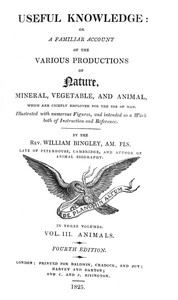
Useful Knowledge: Volume 3. Animals Or, a familiar account of the various productions of nature — Context and Discussion can be approached with a clearer sense of reading commitment from its source measurements: 95,514 words, 6 hr 56 min estimated reading time, and 14 detected text sections.
The text analysis averages about 24.4 words per sentence, while the detected sections provide another way to judge how the source is divided.
Project Gutenberg metadata also associates the work with “Natural history,” connecting these edition facts with the source record’s subject description.
Explore this collection
These alternatives are selected using recorded categories and estimated reading time.
About 417 minutes
Animals
95,700 recorded words. 1 minutes difference from this book's estimate.
View Gutenberg source #38315About 429 minutes
Animals
98,535 recorded words. 13 minutes difference from this book's estimate.
View Gutenberg source #40708About 401 minutes
Animals
92,073 recorded words. 15 minutes difference from this book's estimate.
View Gutenberg source #36504Search stored excerpts and compare books → Choose by your preferences →
Choices use stored catalog measurements. Estimates vary with reading speed. A shared category is a catalog label, not a claim that two books have the same argument or literary quality.
Search reads excerpt text stored with this catalog and links to its associated Gutenberg record. The connection is stored in the site database; this tool does not recheck that every excerpt is word-for-word identical to that external record. Excerpt search does not cover every chapter and does not verify historical publication dates.
Catalog snapshot checked: 2026-09-25. Coverage: 100 public books, 100 available source excerpts.
Read the complete public-domain text at its original source.
Read on Project GutenbergWilliam Bingley's Useful Knowledge: Volume 3. Animals (1825) opens with a crisp definition: animals are 'natural bodies which possess organization, life, sensation, and voluntary motion.' This fourth edition, part of a three-volume set on mineral, vegetable, and animal productions, immediately establishes a dual purpose—instruction and reference. Bingley, a clergyman and naturalist, organizes the animal kingdom into six classes (Mammalia, Birds, Amphibia, Fishes, Insects, Worms) and proceeds species by species, but his focus is relentlessly practical: each entry notes not only structure and habit but also how the creature serves human needs.
Bingley's taxonomy follows Linnaean orders—Primates, Bruta, Ferae, Glires—but his real interest lies in what animals provide. The frontispiece plates illustrate 'Heads, &c. of Quadrupeds' and 'Parts of Mammiferous Animals,' emphasizing physical traits tied to use: the elephant's trunk, the beaver's tail, the horse's limb. In the text, each species is assessed for its material contribution: the wheat-ear is valued for autumn fatness, caught in horse-hair snares on Sussex downs, then pickled or potted for London tables. The nightingale, by contrast, is prized for song, yet Bingley notes that some people 'have a dislike to it,' even preferring frog croaks. This tension between aesthetic and economic worth runs throughout.
Bingley's observations often blend natural history with anecdote. The nightingale's song is described with precision: 'sixteen different beginnings and closes,' a compass of three octaves, and a readiness to 'modulate its voice to a given key' if a person whistles. Yet he also records that caged birds sing nine or ten months, while wild ones sing only ten weeks—a quiet comment on captivity. The wheat-ear entry reveals a symbiotic economy: shepherds catch them, some are eaten locally, others sent to London. The redbreast, 'by no means despicable as a songster,' is noted for its powers of imitation, 'educated under a very fine' (the excerpt cuts off). These details show Bingley's method: close attention to behavior, then a turn to human use or response.
The excerpts cover only the introduction and a few bird species (nightingale, wheat-ear, redbreast), leaving the bulk of the volume—mammals, fish, insects, worms—unseen. Bingley's system is clear: each animal gets a numbered entry with Latin name, physical description, habitat, diet, reproduction, and utility. But the excerpts hint at a broader pattern: the nightingale entry includes a remark about a person who cut down trees to silence them, while delighting in frog croaks. Such asides suggest Bingley's willingness to include human quirks alongside natural facts. Readers should expect a work that is both systematic and idiosyncratic, where Linnaean order meets practical curiosity.
Bingley's volume rewards readers who approach it as a period artifact: a window into early 19th-century natural history that values what animals do for people—whether sing, fatten, or furnish materials. The entries are compact but dense, mixing taxonomy with anecdote. To get the most from this book, read with attention to the small details: the shepherd's snare, the pickled wheat-ear, the nightingale's echo. These are the threads that tie classification to daily life.
Reading Bingley’s careful notes on nightingales, their song weighed against their usefulness, I found myself thinking of how little we truly grasp another creature’s inner life. That lingering question—what their calls actually mean—quietly led me back to Apes and Monkeys: Their Life and Language — A Closer Reading, and its gentle argument that we’ve only just begun to listen.
Use these questions to collect your thoughts before moving on.