About 416 minutes
Useful Knowledge: Volume 3. Animals Or, a familiar account of the various productions of nature — Context and Discussion
Animals
95,514 recorded words. 1 minutes difference from this book's estimate.
View Gutenberg source #58118
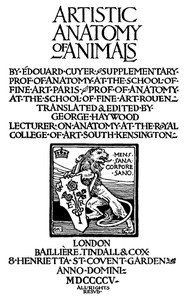
The catalog record for Artistic Anatomy of Animals — Reading Notes provides practical reading context through 95,700 words, 6 hr 57 min estimated reading time, and 16 detected text sections.
The text analysis averages about 23.9 words per sentence, while the detected sections provide another way to judge how the source is divided.
Project Gutenberg metadata also associates the work with “Zoological illustration,” connecting these edition facts with the source record’s subject description.
Explore this collection
These alternatives are selected using recorded categories and estimated reading time.
About 416 minutes
Animals
95,514 recorded words. 1 minutes difference from this book's estimate.
View Gutenberg source #58118About 429 minutes
Animals
98,535 recorded words. 12 minutes difference from this book's estimate.
View Gutenberg source #40708About 401 minutes
Animals
92,073 recorded words. 16 minutes difference from this book's estimate.
View Gutenberg source #36504Search stored excerpts and compare books → Choose by your preferences →
Choices use stored catalog measurements. Estimates vary with reading speed. A shared category is a catalog label, not a claim that two books have the same argument or literary quality.
Search reads excerpt text stored with this catalog and links to its associated Gutenberg record. The connection is stored in the site database; this tool does not recheck that every excerpt is word-for-word identical to that external record. Excerpt search does not cover every chapter and does not verify historical publication dates.
Catalog snapshot checked: 2026-09-25. Coverage: 100 public books, 100 available source excerpts.
Read the complete public-domain text at its original source.
Read on Project GutenbergÉdouard Cuyer opens his preface by acknowledging that the present volume grew directly from his lectures on plastic anatomy at the École des Beaux-Arts, where for nine years he supplemented the teaching of Mathias Duval. He notes that students repeatedly asked to see these lectures collected in book form—a project he had long prepared, gathering materials to fill a perceived void. Cuyer is careful to separate personal authorial sentiment from utility, stating that he wishes to express his opinion on the publication's value while putting aside every personal sentiment of an author. This measured, almost defensive tone recurs throughout the excerpts, as he anticipates objections to anatomical study for artists and argues that conviction in its value must be intense and materially deep.
Cuyer devotes the preface to combating what he calls the idea—as mischievous as it is false—that scientific knowledge hinders artistic representation. He insists that students must not merely admit the value of anatomical studies but be materially and deeply convinced without restriction. This rhetorical strategy frames the entire work as a pedagogical tool, not a dry reference. The author positions himself as a prosector turned lecturer, someone who has trained students to internalize anatomy's utility. The excerpts show him addressing hypothetical skeptics directly, a choice that gives the text an argumentative undercurrent rare in anatomical manuals.
In the section on neck muscles, Cuyer demonstrates his comparative method by tracing how the human sterno-cleido mastoid transforms in animals lacking a clavicle. He explains that the clavicular fasciculi of the trapezius and sterno-cleido mastoid unite with part of the deltoid to form a single muscle, the mastoido-humeralis—a long fleshy band on the lateral neck. The description is precise: the muscle passes obliquely downwards and backwards, covering the scapulo-humeral angle, and inserts into the anterior border of the humerus. Cuyer cites Bourgelat's naming of this muscle as common to the head, neck, and shoulder, grounding his analysis in veterinary tradition.
Cuyer's treatment of the caudal region illustrates his attention to species-specific variation. He describes the lateral sacro-coccygeal muscle, which in the dog arises from the internal border of the iliac bone and the external border of the sacrum, while in the horse it arises from the crest of the sacrum. Both insert into the coccygeal vertebrae and produce lateral movement of the tail. The inferior sacro-coccygeal, a fairly thick muscle, depresses the caudal appendix. These entries are terse, listing origins and insertions without elaboration, yet the comparative detail—dog versus horse—reveals Cuyer's assumption that artists need to know not just generic anatomy but the differences between commonly depicted animals.
The preface mentions a reproduction of a sketch by Barye from the Anatomical Museum of the École des Beaux-Arts, indicating that Cuyer integrated visual references from a renowned animal sculptor. This choice aligns with his stated goal of serving artists: Barye's work exemplifies how anatomical knowledge informs artistic practice. The excerpts, however, contain no further discussion of Barye's sketch, leaving its role unclear. Cuyer's reliance on such visual evidence suggests that the book's illustrations—though not reproduced in the text excerpts—were integral to his teaching method. The author's voice remains that of a lecturer pointing to diagrams, reinforcing the work's origin in live demonstration.
Cuyer's prose is methodical, often beginning paragraphs with a statement of what will be investigated and ending with a summary of findings. Readers should expect a systematic, lecture-like structure: each muscle or bone is introduced, its human counterpart noted, then its modification in animals explained. The author's defensive preface may color the reading experience, but the core content is a straightforward comparative anatomy for artists, grounded in the belief that deep conviction in anatomy's utility is necessary for profitable study.
Reading Cuyer’s lectures on fused muscles, I kept thinking how strange it is that we lose the clavicle’s anchor, and how form follows that hidden loss. It brought back the quieter wonder of Elementary Zoology, Second Edition — Key Ideas to Explore, where such skeletal quirks were simply laid out as life’s patient improvisations. Both feel like old friends explaining the same quiet miracle.
Capture what you thought, learned, and would like to remember.