
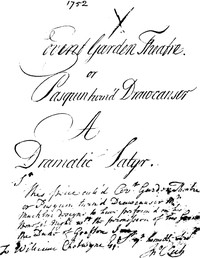
The Covent Garden Theatre, or Pasquin Turn'd Drawcansir by Charles Macklin
So, picture this: It's 1747, and the actor-playwright Charles Macklin is having a really bad year. His latest play at the Covent Garden Theatre is getting torn apart by critics, especially a writer named Samuel Foote who mercilessly parodies him. Instead of just fuming in private, Macklin does something wild. He writes a whole new play—this one—to hit back. He puts his critics right on stage as characters, has them argue about his own failed play, and basically turns his personal and professional grievances into public entertainment. It's the ultimate 'clap back' of the Georgian era.
The Story
The 'plot' is really a series of heated conversations. We're in the Covent Garden Theatre, right after Macklin's play The Suspicious Husband has flopped. A bunch of thinly-veiled versions of real critics and theater folks gather to pick over the carcass of the performance. They bicker about everything: Macklin's acting, the script's quality, the state of London theater, and their own rivalries. Macklin, through his stand-in characters, gets to defend his work, explain his artistic choices, and accuse his enemies of jealousy and bad taste. It's less a traditional story and more a dramatic, no-holds-barred commentary on the play that just happened.
Why You Should Read It
Honestly, the sheer nerve of it is what hooked me. This play pulls back the curtain in a way few works do. You're not just reading a finished product; you're witnessing the raw, immediate reaction to one. It's a fascinating look at how artists dealt with failure and criticism long before Twitter. Macklin isn't some perfect hero—he's prickly, defensive, and clearly settling scores. That makes him feel incredibly human. Reading this is like finding a 270-year-old gossip column mixed with a artist's manifesto. You get the politics, the personalities, and the passion that fueled London's entertainment world.
Final Verdict
This is a niche read, but a delightful one. It's perfect for history buffs and theater geeks who want to go beyond the big Shakespearean names and see the gritty, grimy reality of putting on a show in the 1700s. If you enjoy stories about artistic feuds, meta-commentary, or the messy intersection of art and ego, you'll find this pamphlet-play totally absorbing. It's short, it's specific, and it crackles with the energy of a man who's had just about enough. A unique little time capsule of theatrical revenge.
This is a copyright-free edition. Feel free to use it for personal or commercial purposes.
Brian White
7 months agoPerfect.
Jackson Williams
11 months agoThis is one of those stories where it manages to explain difficult concepts in plain English. Absolutely essential reading.
Elizabeth Harris
1 year agoFast paced, good book.
Betty Torres
1 year agoAfter hearing about this author multiple times, the emotional weight of the story is balanced perfectly. A true masterpiece.






George Davis
1 year agoThis was exactly the kind of deep dive I was searching for, the objective evaluation of the pros and cons is very refreshing. It’s hard to find this much value in a single source these days.