
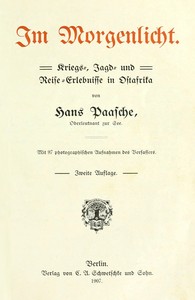
Im Morgenlicht. Kriegs-, Jagd- und Reise-Erlebnisse in Ostafrika by Hans Paasche
Published in 1920, Im Morgenlicht collects the diaries and reflections of Hans Paasche, a German naval officer who served in East Africa before and during World War I. The book isn't a novel with a neat plot, but a journey of the mind, told through episodes of hunting, military campaigning, and travel.
The Story
Paasche arrives in German East Africa (modern-day Tanzania, Rwanda, Burundi) full of national pride and a sense of European superiority. He describes expeditions into the bush, encounters with wildlife, and military skirmishes. But as he spends more time there, learning from local guides and observing colonial administration, his writing shifts. The 'adventure' starts to feel hollow. He details the exploitation of local people, the environmental damage, and the pointless violence of colonial control. The central drama isn't a battle against an enemy army, but Paasche's internal battle against his own conditioning.
Why You Should Read It
What makes this book so powerful is its honesty. Paasche doesn't paint himself as a hero. He shows his own prejudices and then meticulously documents how they fell apart. You feel his anger and shame as he realizes the truth. It's a rare look at colonialism from inside the system, written by someone who had everything to gain by staying silent. His love for the East African landscape is palpable, which makes his critique of its destruction even more poignant. This isn't dry history; it's a confession and an indictment, written with the urgency of someone who just saw the light.
Final Verdict
This is a challenging but essential book for anyone interested in colonial history, moral philosophy, or gripping personal narratives. It's perfect for readers who appreciate primary sources and don't mind a non-linear structure. If you liked the self-reckoning in books like King Leopold's Ghost or the ethical journeys in Joseph Conrad's work, but want a real diary from the heart of the conflict, pick this up. Be warned: it will unsettle you, and it should.
This text is dedicated to the public domain. You can copy, modify, and distribute it freely.
Sarah Johnson
6 months agoI appreciate how this edition approaches the core problem, the way it challenges the status quo is both daring and well-supported. Finally, a source that prioritizes accuracy over hype.
Michael Moore
1 year agoI was particularly interested in the case studies mentioned here, the bibliography and references suggest a high level of research and authority. This should be on the reading list of every serious professional.
William Torres
6 months agoFast paced, good book.
Margaret Wilson
1 year agoThe formatting on this digital edition is flawless.







William Moore
10 months agoThe layout is perfect for tablet and e-reader devices.