
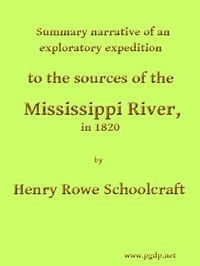
Summary Narrative of an Exploratory Expedition to the Sources of the…
Let's set the scene: it's 1832, and the young United States is pushing west. The government sends an expedition, led by geologist Henry Rowe Schoolcraft, with two big jobs. First, they need to check in on Native American tribes in what's now Minnesota and Wisconsin, delivering gifts and trying to keep the peace. Second, and most famously, they have to settle a geographical debate once and for all: where does the Mississippi River actually begin?
The Story
The book follows Schoolcraft and his team—which includes an army officer, a doctor, and interpreters—as they travel by canoe and on foot from Lake Superior into the dense northern wilderness. It's part diplomatic mission, part scientific survey. They meet with Ojibwe communities, and Schoolcraft, deeply interested in their culture, records languages and stories. But the central thread is the search. Earlier explorers had pointed to Lake Cass and others, but Schoolcraft wasn't convinced. Guided by an Ojibwe leader named Ozawindib, they push further south into a confusing network of lakes and streams. The tension builds not from dramatic danger, but from the slow, meticulous work of elimination. Finally, they reach a clear, small lake that feeds unmistakably into the Mississippi. Schoolcraft, combining Latin and Ojibwe words, names it 'Itasca' (from 'veritas caput' or 'true head'). The mystery is solved.
Why You Should Read It
This isn't a slick, modern adventure tale. The charm is in the details—the lists of supplies, the descriptions of weather, the offhand mentions of feasts with tribes. You get a powerful sense of being there. Schoolcraft's writing shows his dual mind: he's a precise scientist noting rock formations, but also a man genuinely captivated by the people he meets. His act of naming 'Itasca' feels like a perfect moment where exploration, language, and respect for Native guides all come together. It’s a foundational story of American geography, told by the guy who literally put the dot on the map.
Final Verdict
Perfect for history buffs who love primary sources, or anyone fascinated by the early American frontier. If you enjoy the idea of 'armchair exploration'—feeling the grit and grind of a historic journey from your couch—this is a fantastic pick. It's a slow, thoughtful read that rewards patience with a genuine sense of discovery. You'll come away not just knowing where the Mississippi starts, but understanding how much effort and curiosity it took to find out.
This title is part of the public domain archive. You do not need permission to reproduce this work.
Susan Miller
1 year agoLooking at the bibliography alone, the step-by-step breakdown of the methodology is extremely helpful for students. It definitely lives up to the reputation of the publisher.
Richard Jones
10 months agoI found the author's tone to be very professional yet accessible, the chapter on advanced strategies offers insights I haven't seen elsewhere. I’ll definitely be revisiting some of these chapters again soon.
Christopher White
5 months agoA brilliant read that I finished in one sitting.
Richard Brown
1 month agoI was skeptical about the depth of this book at first, but the chapter on advanced strategies offers insights I haven't seen elsewhere. It’s hard to find this much value in a single source these days.







George Miller
1 year agoVery satisfied with the depth of this material.