
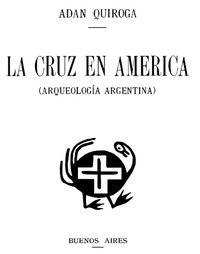
La cruz en América (Arqueología Argentina) by Adán Quiroga
Adán Quiroga's La cruz en América is a book that starts with a simple symbol and ends up questioning everything. Published in the late 19th century, it’s a piece of Argentine archaeology that feels more like an intellectual treasure hunt.
The Story
There isn’t a plot in the novel sense. Instead, Quiroga takes you on his journey of discovery. He begins by cataloging the countless crosses found across the Americas—in Inca temples, on Mapuche textiles, carved into ancient monoliths, and of course, in every Spanish colonial church. His ‘story’ is the argument he builds. He meticulously compares these American crosses with symbols from ancient cultures across Europe and Asia. His goal? To prove that the cross was not a symbol introduced solely by Christian missionaries, but a universal, primal sign that existed independently among the indigenous peoples of the Americas. The narrative tension comes from watching him connect these dots, building a case that challenged the orthodox historical view of his time.
Why You Should Read It
You should read this not for dry facts, but for the thrill of the chase. Quiroga’s passion is contagious. He isn’t a detached academic; he’s a man on a mission, and you’re right there with him as he examines artifacts and puzzles over meanings. The book gives you a raw look at how historical ideas are formed. It’s also a powerful reminder of the deep, complex cultural layers in the Americas. The cross becomes a lens to see the collision and fusion of worlds. It makes you look at familiar symbols in a completely new light and wonder about the stories baked into the land itself.
Final Verdict
This is a niche but fascinating read. It’s perfect for history buffs who enjoy alternative theories and early archaeological writing. If you’re interested in the symbols that shape cultures, or if you just love a good historical mystery, you’ll find a lot to chew on. A heads-up: it’s a product of its time, so some language and concepts feel dated. But that’s also part of its charm—it’s a snapshot of a brilliant mind trying to make sense of his world. Approach it not as absolute truth, but as a compelling, passionate argument from a forgotten pioneer.
This historical work is free of copyright protections. Thank you for supporting open literature.
Sarah Harris
3 months agoIt effectively synthesizes complex ideas into a coherent whole.
Matthew Lee
9 months agoI appreciate how this edition approaches the core problem, the way it challenges the status quo is both daring and well-supported. Finally, a source that prioritizes accuracy over hype.
Mary Rodriguez
11 months agoOne of the most comprehensive guides I've read this year.
Paul Hernandez
6 months agoHaving followed this topic for years, I can say that the critical analysis of current industry standards is very timely. I'll be citing this in my upcoming project.



Ashley Jones
1 year agoI've been looking for a reliable source on this topic, and the footnotes provide extra depth for those who want to dig deeper. I'll be recommending this to my students and colleagues alike.