
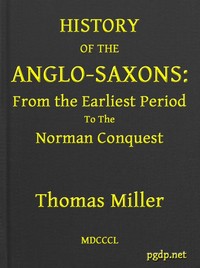
History of the Anglo-Saxons, from the Earliest Period to the Norman Conquest
Imagine the end of Roman Britain. The legions are gone, leaving behind empty forts and crumbling roads. Into this power vacuum sail boatloads of Germanic warriors and their families from what is now Denmark and northern Germany. Thomas Miller's book follows these people—the Anglo-Saxons—from their first rough landings through to their final, fateful stand against William the Conqueror at Hastings.
The Story
Miller doesn't just give you a timeline. He builds a world. He starts with the shadowy, early settlement period, where small kingdoms rose and fell. You'll meet figures like the legendary King Arthur (who Miller treats as a possible Romano-British leader fighting the Saxons) and then more historical kings like Alfred the Great, who famously fought off the Vikings and sparked a cultural revival. The book tracks the political rollercoaster: the uniting of England, the brutal Viking invasions that nearly broke it apart, and the shaky restoration under later kings like Edward the Confessor. The final act is the Norman Conquest, presented not just as a battle, but as the catastrophic end of an entire era.
Why You Should Read It
What I loved was how human it all feels. This isn't a story about a perfect, noble people. It's about ambition, survival, and messy politics. You see them creating things we take for granted: the English language (though it sounds very different!), the idea of a unified English kingdom, and early legal codes. Miller, writing in the 1800s, has a clear passion for this as England's origin story. Reading it, you get a real sense of momentum—of a culture being built piece by piece, often through violence and struggle, only to be replaced. It makes 1066 feel less like a simple change of ruler and more like a profound cultural earthquake.
Final Verdict
This is a classic for a reason. It's perfect for anyone curious about the roots of England, especially if you enjoy historical fiction about Vikings or the medieval period and want to know the real history behind it. Be warned, it's a 19th-century history, so the prose is a bit more formal than modern books, but Miller's enthusiasm is contagious. If you want to understand the deep foundation of English history—the layer beneath the knights and castles—this is a fascinating and essential place to start.
The copyright for this book has expired, making it public property. You are welcome to share this with anyone.
David Davis
7 months agoHaving explored several resources on this, I find that the breakdown of complex theories into digestible segments is masterfully done. It’s a comprehensive resource that doesn't feel bloated.
Donald Miller
1 year agoAs a long-time follower of this subject matter, the objective evaluation of the pros and cons is very refreshing. Definitely a five-star contribution to the field.
David Brown
6 months agoI was skeptical about the depth of this book at first, but the author doesn't just scratch the surface but goes into meaningful detail. This should be on the reading list of every serious professional.
Emily Brown
10 months agoI was particularly interested in the case studies mentioned here, it addresses the common misconceptions in a very professional manner. An excellent example of how quality digital books should be formatted.









Karen Moore
6 months agoThe methodology used in this work is academically sound.