
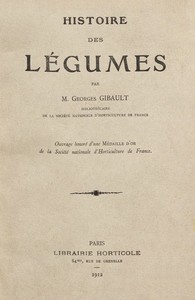
Histoire des légumes by Georges Gibault
Okay, let's clear something up right away: Histoire des légumes is not a cookbook. You won't find a single recipe in here. What you will find is a meticulously researched, surprisingly lively chronicle of the plants we put on our plates. Georges Gibault, writing in the early 20th century, acts as a detective of the dinner table, tracing the origins and global migrations of vegetables from antiquity to his own time.
The Story
Think of this book as a series of interconnected biographies, but for produce. Gibault gives each vegetable its due. He starts with the basics: where it was first domesticated. Then, he follows its path across continents. He shows how the carrot, originally purple or white, was selectively bred in the Netherlands to become the orange symbol of the Dutch royal family. He explains how the artichoke was a luxury item in Renaissance courts. The narrative is built from a patchwork of sources—Roman agricultural writers, medieval herbalists, accounts from explorers like Columbus, and notes from everyday market gardeners. It's the story of how war, politics, royalty, and sheer human curiosity shaped our diets.
Why You Should Read It
I picked this up expecting a dry reference text, but I was completely charmed. Gibault's passion is contagious. The best parts are the odd historical footnotes he uncovers. Learning that Catherine de' Medici is credited with popularizing green beans in France, or that peas were such a status symbol in 17th-century Paris that they were eaten fresh with a tiny spoon made of silver or gold, adds a layer of magic to everyday meals. It reframes history through a lens we can all understand: food. You start to see the Columbian Exchange not just as a map in a textbook, but as the moment tomatoes met pasta and chili peppers met Asian cuisine. It makes the past feel tangible and delicious.
Final Verdict
This is a niche book, but a wonderful one. It's perfect for foodies, gardeners, and anyone with a curiosity about the hidden stories in everyday life. If you love shows or podcasts that explore the history of common objects, you'll adore this. It's not a page-turner in the traditional sense, but it's the kind of book you can dip into for a chapter at a time, each time coming away with a fun fact to share at dinner. Fair warning: it was written in 1912, so some of the botanical classifications are dated, but that almost adds to its charm. It's a time capsule of both vegetables and the way we once studied them. A truly unique and satisfying read.
This work has been identified as being free of known copyright restrictions. Feel free to use it for personal or commercial purposes.
Michael Moore
10 months agoI found the data interpretation to be highly professional and unbiased.
Karen Miller
10 months agoA brilliant read that I finished in one sitting.
Paul Johnson
1 month agoRight from the opening paragraph, it addresses the common misconceptions in a very professional manner. Thanks for making such a high-quality version available.
Christopher Moore
2 years agoI wanted to compare this perspective with traditional views, the transition between theoretical knowledge and practical application is seamless. I’ll definitely be revisiting some of these chapters again soon.






William Perez
11 months agoAs a professional in this niche, the logic behind each conclusion is easy to follow and verify. The insights gained here are worth every minute of reading.