About 88 minutes
On the Seashore Cassell's "Eyes and No Eyes" Series, Book VII — Reading Notes
Animals
20,065 recorded words. 19 minutes difference from this book's estimate.
View Gutenberg source #10513
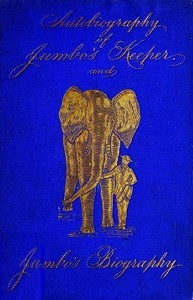
The source record for Autobiography of Matthew Scott, Jumbo's Keeper; Also Jumbo's Biography, by the same Author — Key Ideas to Explore measures this digital text at 15,844 words, 1 hr 9 min estimated reading time, and 2 detected text sections.
The text analysis averages about 26.2 words per sentence, while the detected sections provide another way to judge how the source is divided.
Project Gutenberg metadata also associates the work with “Jumbo (Elephant),” connecting these edition facts with the source record’s subject description.
Explore this collection
These alternatives are selected using recorded categories and estimated reading time.
About 88 minutes
Animals
20,065 recorded words. 19 minutes difference from this book's estimate.
View Gutenberg source #10513About 90 minutes
Animals
20,597 recorded words. 21 minutes difference from this book's estimate.
View Gutenberg source #44056About 40 minutes
Animals
9,185 recorded words. 29 minutes difference from this book's estimate.
View Gutenberg source #29563Search stored excerpts and compare books → Choose by your preferences →
Choices use stored catalog measurements. Estimates vary with reading speed. A shared category is a catalog label, not a claim that two books have the same argument or literary quality.
Search reads excerpt text stored with this catalog and links to its associated Gutenberg record. The connection is stored in the site database; this tool does not recheck that every excerpt is word-for-word identical to that external record. Excerpt search does not cover every chapter and does not verify historical publication dates.
Catalog snapshot checked: 2026-09-25. Coverage: 100 public books, 100 available source excerpts.
Read the complete public-domain text at its original source.
Read on Project GutenbergMatthew Scott opens his 1885 memoir by declaring he will give 'a faithful record of my life,' and the voice that follows is strikingly direct and personal. Born at Knowsley, the seat of the Earls of Derby, Scott frames his humble start as a 'self-made man' whose knowledge came from living 'with wild beasts.' The narrative is as much about his bond with Jumbo as about his own history; he describes sharing 'day and night' with the elephant for twenty years. Scott's prose often addresses readers as 'you,' creating an intimate, almost conversational tone that blurs the line between autobiography and animal biography.
Scott introduces himself not through grand achievements but through his association with Jumbo. He writes that he has 'very little to boast of with regard to this world’s goods,' yet he claims a unique authority: 'the knowledge and experience I possess, I have learned while living with wild beasts.' This self-deprecating yet proud stance recurs throughout. He dedicates the book to the people of the United States and Great Britain, thanking them for kindness received during his travels. The dedication's phrasing—'If “Jumbo” could but speak, I know he would endorse what I say here'—reveals Scott's tendency to speak for his charge, a rhetorical move that shapes the entire work.
Scott attributes to Jumbo a refined sensitivity to music. He recounts that at the Zoölogical Gardens in London, Jumbo could distinguish the 'Horse Guards' band from a substitute, even when he could not see the musicians. Scott marvels that 'many boys now of only the age that Jumbo was at that time, who would not be able to distinguish the difference.' The anecdote serves dual purposes: it showcases Jumbo's intelligence and reinforces Scott's role as the one who notices and interprets such behavior. Scott's language here is affectionate but not sentimental; he presents the elephant's preference as a matter of fact, supported by his own observation.
Scott recounts the decision to bring Jumbo to America, emphasizing the skepticism he faced. 'It was held—and a good deal of pressure was brought to bear upon me—that I should never be able to make the voyage across the Atlantic in safety.' He names P. T. Barnum as 'The Greatest Showman on Earth' and describes his own consent 'after considerable persuasion.' The tone is matter-of-fact, but Scott injects a note of pride when he reflects on the 'tens of thousands of miles Jumbo and I have travelled.' He frames the journey as a shared adventure, and his curiosity about 'what kind of reception would be accorded Jumbo' underscores his role as both caretaker and showman.
Scott does not shy from describing Jumbo's less majestic traits. He confesses that Jumbo has 'some habits that are rather babyish,' such as whining and crying when Scott is overdue, 'just the same as a child crying after its mother.' Scott directly addresses his 'young readers,' asking for forgiveness: 'As you remember you have done the same thing yourselves.' This passage reveals Scott's didactic impulse—he uses Jumbo's behavior to teach charity and forgiveness. The anthropomorphism is deliberate and unapologetic, and it reinforces the intimate, domestic quality of their relationship. Scott's voice here is that of a fond but honest caretaker.
Scott's narrative is best approached as a dual portrait: the keeper and the kept. His prose is unpolished but earnest, and his observations—whether about Jumbo's musical ear or his separation anxiety—are grounded in daily proximity. Readers interested in the human-animal bond, 19th-century showmanship, or the voice of a working-class autobiographer will find this a singular document. Scott's humility and pride are equally present, and his story is inseparable from the elephant he raised.
Reading Scott’s account, I felt his quiet pride in raising Jumbo from a sickly calf — that tender, stubborn loyalty between a man and a beast. It reminded me of flipping through an old Beginners' zoology — Story, Setting & Ideas as a child, where animals were still mysteries, not exhibits. That same wondering gaze, I think, stayed with him, too.
Use these questions to collect your thoughts before moving on.