
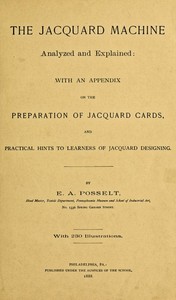
The Jacquard Machine Analyzed and Explained by E. A. Posselt
Forget everything you think you know about dry technical manuals. The Jacquard Machine Analyzed and Explained is a detective story about a piece of hardware. Published in the late 19th century by expert weaver E.A. Posselt, this book tackles a single, brilliant invention: Joseph Marie Jacquard's loom attachment from 1804.
The Story
There's no protagonist in the traditional sense. The 'character' is the machine itself. Posselt walks us through, step-by-step, how this contraption worked. Before Jacquard, creating complex woven pictures with silk required a skilled weaver and a helper for every single thread in the pattern—a slow, expensive nightmare. Jacquard's genius was using a chain of punched cards. Each hole in the card told a specific hook whether to lift a thread or not. By stringing these cards together, you could 'program' the loom to weave incredibly detailed portraits, landscapes, and patterns automatically. Posselt breaks down each gear, hook, and card, translating the machine's physical logic into something a dedicated reader can truly grasp.
Why You Should Read It
What grabbed me was the sheer elegance of the idea. This isn't just a weaving guide. You're literally looking at the great-grandfather of the computer. Those punch cards? They directly inspired the earliest data processing. Reading Posselt's clear explanations, you feel the click of understanding—how a binary system (thread up, thread down) controlled by punched paper could create boundless beauty. It makes you see technology and art as partners, not opposites. Posselt’s passion as a practitioner shines through; he wants you to get it, not just memorize it.
Final Verdict
This book is a hidden gem for a specific but curious reader. It's perfect for history buffs who love 'how things work' deep dives, textile artists wanting to understand their craft's roots, or anyone in tech who enjoys a tangible origin story for programming. It’s not a breezy novel, but if you have the patience for a detailed, loving autopsy of a world-changing invention, you'll find it incredibly rewarding. You'll never look at a patterned fabric—or a line of code—the same way again.
This book is widely considered to be in the public domain. It serves as a testament to our shared literary heritage.
Emily Lopez
1 year agoIt effectively synthesizes complex ideas into a coherent whole.
Barbara Jones
1 year agoThe digital formatting makes it very easy to navigate.
Christopher Moore
2 months agoThought-provoking and well-organized content.
John Moore
3 months agoFrom a researcher's perspective, the way it challenges the status quo is both daring and well-supported. A mandatory read for anyone in this industry.


Susan Garcia
5 months agoGiven the current trends in this field, it addresses the common misconceptions in a very professional manner. A mandatory read for anyone in this industry.