
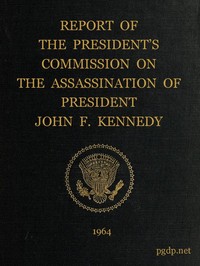
Report of the President's Commission on the Assassination of President John F.…
Let's be clear: this isn't a story in the traditional sense. There's no main character or plot twist written by an author. The 'story' here is an investigation. On November 22, 1963, President John F. Kennedy was shot and killed in Dallas, Texas. In the chaos that followed, Lee Harvey Oswald was arrested, only to be murdered himself two days later by Jack Ruby. With the prime suspect dead and the nation reeling, President Lyndon Johnson appointed a special commission, led by Chief Justice Earl Warren, to find out what happened.
The Story
The book is their final report. It walks you through their entire process. They start with the motorcade route and the shots from the Texas School Book Depository. They detail Oswald's life, his time in the Soviet Union, and his actions in the weeks leading up to the assassination. Then, they methodically present the evidence: the rifle, the bullet fragments, the eyewitness accounts. The core narrative they build is a straightforward one: Oswald, a disgruntled former Marine, acted alone. They address the major questions head-on—like the 'single bullet theory'—explaining how they reached their conclusions. It's a cold, clinical attempt to stitch together a coherent timeline from the fragments of a national tragedy.
Why You Should Read It
You should read it because this is the source. Every documentary, every conspiracy theory, every history book references this document. Reading it yourself cuts out the middleman. You see the logic, but you also see the gaps and the assumptions. There's a strange power in reading the dry, legalistic prose describing something so emotionally charged. It lets you engage with the facts on your own terms, before anyone else tells you what to think. It's less about agreeing with the verdict and more about understanding how it was reached.
Final Verdict
This is for the curious reader, not the casual one. It's perfect for anyone interested in modern American history, true crime, or how governments respond to crisis. If you love dissecting mysteries and examining primary sources, you'll find it gripping. If you prefer a fast-paced narrative, you might find parts of it slow. But if you want to have an informed opinion on one of history's biggest 'what ifs,' this is the essential, if daunting, starting point. Think of it as the case file on the most important murder of the 20th century.
This text is dedicated to the public domain. Knowledge should be free and accessible.
Michelle Jones
7 months agoAs someone who reads a lot, the author's voice is distinct and makes complex topics easy to digest. I learned so much from this.








Eric Jones
1 month agoHello Abgoa Com Owner, My name is Eric and I’m betting you’d like your website Abgoa Com to generate more leads. Here’s how: Web Visitors Into Leads is a software widget that works on your site, ready to capture any visitor’s Name, Email address, and Phone Number. It signals you as soon as they say they’re interested – so that you can talk to that lead while they’re still there at Abgoa Com. Visit https://blastleadgeneration.com to try out a Live Demo with Web Visitors Into Leads now to see exactly how it works and even give it a try… it could be huge for your business. Plus, now that you’ve got their phone number, with our new SMS Text With Lead feature, you can automatically start a text (SMS) conversation quickly… which is so powerful because connecting with someone within the first 5 minutes is 100 times more effective than waiting 30 minutes or more later. The new text messaging feature lets you follow up regularly with new offers, content links, even just how are you doing? notes to build a relationship. Everything I’ve just described is extremely simple to implement, cost-effective, and profitable. Visit https://blastleadgeneration.com to discover what Web Visitors Into Leads can do for your business, potentially converting up to 100 times more eyeballs into leads today! Eric PS: Studies show that 70% of a site’s visitors disappear and are gone forever after just a moment. Don’t keep losing them. Web Visitors Into Leads offers a complimentary 14-day trial – and it even includes International Long Distance Calling. You have customers waiting to talk with you right now… don’t keep them waiting. Visit https://blastleadgeneration.com to try Web Visitors Into Leads now. If you'd like to Want to receive fewer emails, or none whatsoever? Update your email preferences by visiting https://blastleadgeneration.com/unsubscribe.aspx?d=abgoa.com