About 167 minutes
The Insect Folk — Reading Notes
Insects
38,335 recorded words. 6 minutes difference from this book's estimate.
View Gutenberg source #18790
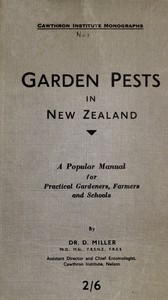
For Garden Pests in New Zealand A Popular Manual for Practical Gardeners, Farmers and Schools — A Closer Reading, the stored edition analysis reports 36,965 words, 2 hr 41 min estimated reading time, and 6 detected text sections.
The text analysis averages about 25.3 words per sentence, while the detected sections provide another way to judge how the source is divided.
Project Gutenberg metadata also associates the work with “Insect pests,” connecting these edition facts with the source record’s subject description.
Explore this collection
These alternatives are selected using recorded categories and estimated reading time.
About 167 minutes
Insects
38,335 recorded words. 6 minutes difference from this book's estimate.
View Gutenberg source #18790About 150 minutes
Insects
34,381 recorded words. 11 minutes difference from this book's estimate.
View Gutenberg source #21948About 184 minutes
Insects
42,208 recorded words. 23 minutes difference from this book's estimate.
View Gutenberg source #48394Search stored excerpts and compare books → Choose by your preferences →
Choices use stored catalog measurements. Estimates vary with reading speed. A shared category is a catalog label, not a claim that two books have the same argument or literary quality.
Search reads excerpt text stored with this catalog and links to its associated Gutenberg record. The connection is stored in the site database; this tool does not recheck that every excerpt is word-for-word identical to that external record. Excerpt search does not cover every chapter and does not verify historical publication dates.
Catalog snapshot checked: 2026-09-25. Coverage: 100 public books, 100 available source excerpts.
Read the complete public-domain text at its original source.
Read on Project GutenbergDavid Miller opens his manual with a clear purpose: to help practical gardeners, farmers, and schools identify and control common animal inhabitants of New Zealand gardens. He explicitly avoids scientific jargon, though he acknowledges that some technical terms are unavoidable. The introduction sets a tone of accessibility, warning that memorising scientific names without knowing the animals is as useless as memorising a telephone directory. This practical orientation is reinforced by the book's structure: it begins with general chapters on the animal kingdom, soil organisms, and insect structure before moving to specific pest groups.
The table of contents reveals a deliberate progression. The first four chapters establish foundational knowledge: a review of the animal kingdom, soil organisms and fertility, insect structure, and life histories. Only then does Miller turn to specific pest categories—sucking insects, leaf-feeders, borers, and miscellaneous pests. This structure suggests that Miller expects readers to build understanding gradually. The excerpts show that even within chapters on specific pests, he provides life-cycle details, such as the apple leaf-hopper's egg-laying in plant tissues and the development of wings in young hoppers. Such details equip the reader to recognise pests at different stages.
Miller's prose is direct and descriptive, avoiding florid language. He uses analogies sparingly but effectively: the poplar gall aphis gall is described as having an opening that presents 'much the same appearance as the mouth of a sack gathered together and tied.' This concrete imagery helps the reader visualise the structure. He also employs precise, non-technical terms for symptoms, such as 'silvering of the foliage' caused by thrips, and mentions 'minute specks of hardened excreta' as a diagnostic clue. The language consistently prioritises identification and control over abstract discussion.
Across the excerpts, a consistent pattern emerges in how Miller presents each pest. He typically names the pest, describes its appearance and life cycle, notes the damage it causes, and then recommends a control method. For example, the greenhouse whitefly is described as having 'body and wings covered with mealy wax,' its eggs laid in circular batches, and the best check being fumigation with calcium cyanide. This formulaic approach makes the manual easy to consult for quick reference. The pattern also reinforces the book's practical aim: each entry is a self-contained guide to action.
The excerpts cover only a portion of the book—the introduction, parts of Chapter VI on sucking insects, and the beginning of Chapter VII on leaf-feeders. From these, we can infer that Miller addresses both common and less familiar pests, such as the North American poplar gall aphis, which has a complex life cycle involving migration between poplar and cruciferous plants. The inclusion of such detail suggests the book aims for thoroughness. However, the excerpts do not reveal how Miller handles the later chapters on boring insects, miscellaneous pests, or the principles of pest control. Readers should expect a similar level of detail throughout.
For a first reading, focus on the early chapters to grasp Miller's classification system and terminology. Then use the later chapters as a reference when encountering specific pests. The book rewards readers who treat it as a field guide rather than a narrative: look up the pest, note the life cycle and control method, and apply the knowledge directly. Miller's emphasis on observation over memorisation is the key to getting the most out of this manual.
It’s funny how some books stay with you less for what they say than how they say it—Miller’s manual feels like that, a steady hand in the garden. I caught myself thinking of The Insect Folk — Reading Notes afterward, the way both treat small lives with quiet respect. A gentle sort of companionship, really. I still feel it.
A brief reflection can help important ideas stay with you longer.