
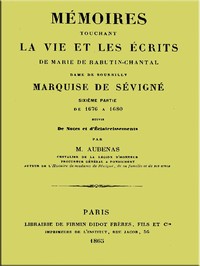
Mémoires touchant la vie et les écrits de Marie de Rabutin-Chantal, (6/6)
Let's be clear from the start: this isn't a novel. It's a biography written in 1868 about a woman from the 1600s. The subject is Marie de Rabutin-Chantal, who the world knows as Madame de Sévigné. She's legendary for the thousands of charming, sharp, and insightful letters she wrote to her daughter, which became a national treasure in France.
The Story
But Aubenas faces a huge problem. While Sévigné's letters are everywhere, her personal life is a blank page. She didn't keep a journal. Her private papers vanished. Aubenas has to become a historical detective. He scours archives for any trace of her: marriage contracts, property deeds, court records, and fleeting references in the memoirs of her famous friends. The "story" here is his investigation. We follow him as he tries to build a picture of her childhood as an orphan, her life as a young widow in the glittering and dangerous court of Louis XIV, and her relationships beyond the famous letters. The book is his report on what he found—and, just as importantly, what he couldn't find.
Why You Should Read It
This book fascinated me because it's so honest about the limits of history. Aubenas doesn't pretend to have all the answers. You feel his frustration and his small triumphs. He'll spend pages analyzing a single line from a legal document to guess at her financial situation, or try to understand her character by looking at the friends she chose. It turns the process of writing history inside out. You're not just learning about Madame de Sévigné; you're sitting alongside a 19th-century scholar as he digs through dusty archives, trying to give shape to a shadow. It makes you appreciate how fragile a person's memory can be, and how much work goes into preserving even the basic outline of a life.
Final Verdict
This is a niche read, but a rewarding one. It's perfect for history buffs who enjoy seeing how the sausage is made—the careful, sometimes frustrating work of historical reconstruction. It's also great for fans of Madame de Sévigné's letters who want to know about the woman holding the pen, even if the portrait is sketched in faint lines. If you prefer fast-paced narratives with clear conclusions, this might feel slow. But if you like the idea of a quiet, intellectual detective story set in the archives of Paris, you'll find it completely absorbing.
This masterpiece is free from copyright limitations. Knowledge should be free and accessible.
Noah Ramirez
1 year agoComprehensive and well-researched.
Deborah Jones
7 months agoVery helpful, thanks.
Emma Lopez
8 months agoFrom the very first page, the pacing is just right, keeping you engaged. This story will stay with me.
Anthony Robinson
3 months agoThe index links actually work, which is rare!







Christopher Torres
1 year agoVery interesting perspective.