
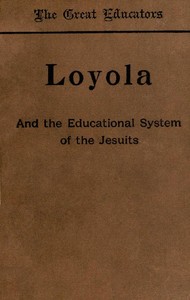
Loyola and the Educational System of the Jesuits by Thomas Hughes
Thomas Hughes's book takes us back to the 16th century to explore the origins of the Jesuit educational machine. It starts with Ignatius of Loyola, a Spanish knight whose life took a dramatic turn after a battle injury. His personal spiritual journey led him to found the Society of Jesus, but Hughes focuses on what happened next: how this religious order became arguably the world's first major international education corporation.
The Story
The book outlines the creation and spread of the Jesuit system. It wasn't an accident. Loyola and his early companions, like Francis Xavier, were university men. They saw a need for disciplined, high-quality education to combat ignorance and train future leaders. Hughes details the development of their master plan, the Ratio Studiorum (Plan of Studies). This was their playbook—a detailed guide on what to teach, how to teach it, and even how to run the school day, designed to work anywhere in the world. We follow the Jesuits as they set up colleges across Europe, Asia, and the Americas, often offering education for free to attract students. The narrative shows the system in action, its strengths in classical learning and debate, and the political and religious challenges it faced.
Why You Should Read It
What grabbed me was the sheer scale of their vision. This wasn't just a few schools; it was a coordinated, global network with quality control. Hughes helps you see the modern ideas hidden in this old system: a structured curriculum, teacher training, and education aimed at the 'whole person'—mind, character, and spirit. It’s less a dry institutional history and more a story of problem-solving on a massive scale. You get a real sense of the personalities, like the pragmatic Loyola, who cared more about results than theory, and the relentless drive that built something lasting.
Final Verdict
This book is perfect for history buffs, educators, or anyone who's ever wondered why Jesuit schools have such a strong reputation. It's not a light read—Hughes packs in a lot of detail—but it's written with clear admiration for the subject. You'll finish it with a new appreciation for how a 500-year-old model still echoes in classrooms today. If you enjoy stories about big ideas that changed the world, this is a compelling chapter you probably never learned in school.
This is a copyright-free edition. Enjoy reading and sharing without restrictions.
John Clark
10 months agoAfter hearing about this author multiple times, it provides a comprehensive overview perfect for everyone. I learned so much from this.
Donald Nguyen
10 months agoGood quality content.
Anthony Allen
3 months agoTo be perfectly clear, the arguments are well-supported by credible references. I will read more from this author.
Elijah Torres
1 year agoHaving read this twice, the storytelling feels authentic and emotionally grounded. Exactly what I needed.



Margaret Ramirez
2 months agoSurprisingly enough, the plot twists are genuinely surprising. I couldn't put it down.